Healthcare access insights from PAN’s Center for Patient Research in 2025: Part III
During our transition, where to find information about:
- Our merged organization: uniting.patientadvocate.org
- Financial assistance: totalassist.org
- Additional direct patient services and resources: patientadvocate.org
- Education: panfoundation.org and education.patientadvocate.org
- Clinical trials education: clinicaltrials.panfoundation.org
- Advocacy: npaf.org
- Research: patientinsightinstitute.org
As we move toward the end of 2025, PAN’s Center for Patient Research continues to shed light on the barriers patients face around healthcare access, key education needs, and their experiences with advocacy.
Over the past three months, we’ve released polls exploring the patient experience and understanding of Medicare open enrollment and Part D reforms, challenges accessing obesity care, experiences advocating for healthcare policy change, and concerns around decreases in medication coverage.
Our research builds on PAN’s commitment to accelerating access to affordable care for everyone. The insights we capture help us strengthen our financial assistance, advocacy, and education initiatives and ensure the patient experience remains central to our work.
I invite you to explore our third-quarter polling below.
More education needed on Medicare open enrollment and Part D reforms
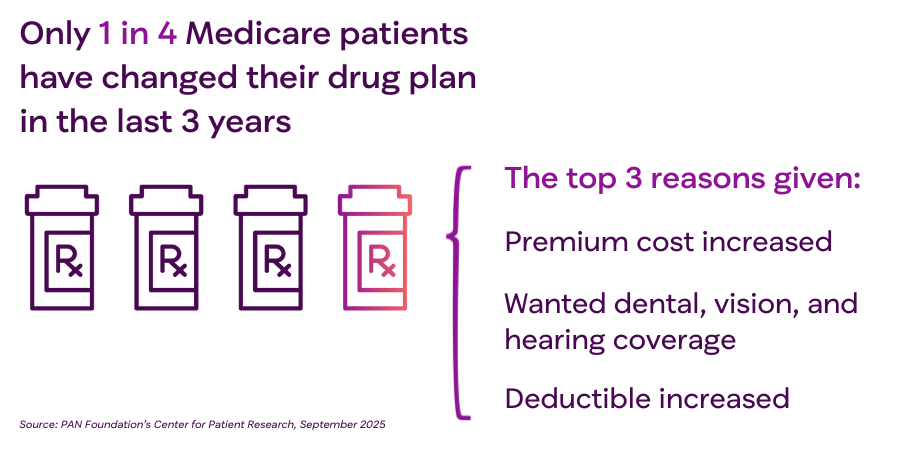
PAN’s Center for Patient Research conducted a national poll exploring the patient experience and understanding of Medicare open enrollment and recent Medicare Part D reforms. The poll findings point to the continued need for more awareness and education to help people understand and navigate Medicare open enrollment and the recent Medicare Part D reforms that benefit patients.
- Only 1 in 4 Medicare patients have changed their drug plan in the last three years. Of those who did, an increase in their premium was the top reason.
- Nearly 4 in 10 (37 percent) Medicare beneficiaries have not heard of the Medicare Part D cap reform and nearly half (48 percent) have never heard of the Medicare Prescription Payment Plan.
- Among those who are aware of these reforms, most Medicare beneficiaries (73 percent) find both the Medicare Part D cap and Medicare Prescription Payment Plan personally helpful.
People enrolled in Medicare face challenges accessing and affording obesity medications
In August, PAN’s Center for Patient Research conducted a national poll, which found that most people (85 percent) enrolled in Medicare who have been diagnosed with and prescribed medications for obesity have faced challenges accessing and affording those medications.
- The top challenge was that their healthcare providers had to change their obesity treatment prescription to alternative medications that were covered by their insurance (51 percent).
- Among those who have faced challenges, about half say they never started their obesity treatment medications.
- Most people (84 percent) enrolled in Medicare who have been diagnosed with obesity reported they would likely seek services from other healthcare providers (e.g., registered dietician, obesity specialist) to support their obesity treatment if it were covered by insurance.

People want to advocate for healthcare policy changes, but need to be invited and given a place to start
In August, PAN’s Center for Patient Research released findings that a quarter of adults (24 percent) living with a chronic health condition have advocated for healthcare policy changes in the past year. Among those, most people (61 percent) report advocating to support the needs of others.
- Among the 76 percent who did not participate in healthcare advocacy over the past 12 months, the reasons included not being asked (25 percent), uncertainty about where to start (25 percent), and not knowing how to get involved (22 percent)
- Among those who advocated, activities included social media (50 percent), contacting representatives (34 percent), attending a town hall (29 percent), and participating in online campaigns (29 percent).
- Among adults participating in advocacy, almost half reported that key benefits were raising awareness of particular healthcare issues in their community (48 percent) and encouraging others to get involved in advocacy (44 percent).

More than half of patients report health insurance denied coverage for critical medications
In July, PAN’s Center for Patient Research released national poll findings that over half (54 percent) of insured adults with commercial insurance have been told by their health insurance plan that medications for their chronic or rare disease are no longer covered.
- Nearly half of commercially insured adults (48 percent) report that their health insurance plan referred them to work with an external company to obtain their medications, causing delays and negative impacts on their health and life.
- About two in five adults (39 percent) opted to work with the external company their insurance plan referred them to.
- Among those who opted to work with an external company, over one-third (39 percent) experienced a delay of one month or more from the time their medication was prescribed to when they began their treatment. In some cases, the delays were longer.
- These delays adversely affected nearly all adults (92 percent).
Related resources
- Medicare open enrollment
- Medicare education resources
- Obesity disease fund
- Letter to the sponsors of the Treat and Reduce Obesity Act (TROA)
- Grassroots campaign to support TROA
- PAN’s Advocacy Action Center
About PAN’s Center for Patient Research
The PAN Foundation’s Center for Patient Research provides insights into the diverse needs of patients as they navigate the challenges of accessing affordable, equitable healthcare.
Through rigorous methodologies, we aim to understand the challenges faced by patients, translate these findings into actionable knowledge for healthcare stakeholders and policymakers, and help inform policies and educational opportunities leading to accessible, affordable, and equitable healthcare for all.

Stay connected with PAN
Sign up for email news from PAN and you’ll receive our patient-centered research reports, educational guides, advocacy action alerts, and more.