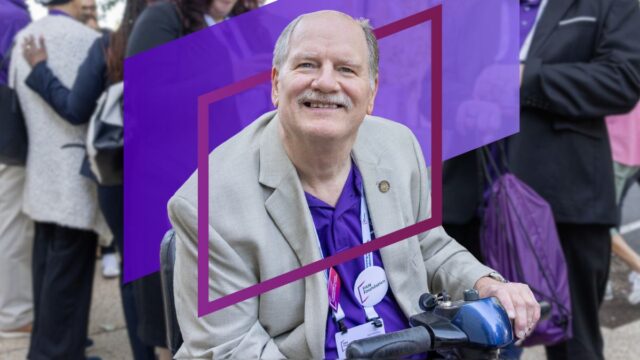
Scott: the power of patience
Information about this website: Following the March 2026 merger of Patient Advocate Foundation and the PAN Foundation, this website is now a part of Patient Advocate Foundation and remains active during our website transition.
Where to find information during our transition:
- About the merged organization: uniting.patientadvocate.org
- Financial assistance: totalassist.org
- Additional direct patient services and resources: patientadvocate.org
- Education: panfoundation.org and education.patientadvocate.org
- Clinical trials education: clinicaltrials.panfoundation.org
- Advocacy: npaf.org
- Research: patientinsightinstitute.org
Decades of living with multiple sclerosis (MS) have taught Scott to be more patient.
Patient with himself. Patient getting the healthcare he needs. Patient as he advocates for himself and others with chronic conditions.
But patience doesn’t come easily to Scott, a former “adrenaline junkie” who dedicated his career to the airline industry, where every second counts. “I had to learn not to get frustrated because things take a lot longer to do [with MS]. It could take me literally an hour to tie both shoes,” he explained.
Scott was diagnosed with MS in February 2000, after years of mysterious symptoms. By 2001, he had a slight limp; by 2002, he was using a cane. By 2003, he was using crutches, and by 2005 he was relying on a scooter. Today, he uses a powered wheelchair to get around.
When the PAN Foundation asked me to go to Washington, D.C., and talk about it, I felt like I could possibly keep that from happening to somebody like me.”
Scott, on his experience with insurance prior authorizations and step therapy delaying his MS treatment
Before his diagnosis, Scott enjoyed hiking, scuba diving, skiing, golfing, and riding his motorcycle. “It was a quick slide, it was shocking,” he said of MS’s effect on his health and mobility.
And he’ll never forget the doctor’s parting words: “I hope you have good insurance, because MS is a very expensive disease.”
Scott did have employer-sponsored health insurance to help cover the costs of MS, a progressive disease of the central nervous system. But that didn’t mean getting treatment would be easy—or affordable.
MS often requires lifelong treatment to both prevent and manage debilitating symptoms and protect a person’s quality of life. Newer therapies can help slow the damage to myelin, which protects nerve cells in the brain and spinal cord. But each MS advancement is a double-edged sword when you must jump through countless hoops to get it, Scott pointed out.
From the beginning, his doctor prescribed “the best stuff out there.” But Scott learned he needed to obtain prior authorization from his health insurance company, which could take weeks. “I didn’t understand that concept. How could a prescription not be approved?” he recalled.
These delays were compounded by the insurer’s step therapy policy, also known as “fail first.” Every time the doctor recommended a new, more effective drug, Scott was forced first to prove that older, less expensive medications didn’t work. Meanwhile, his symptoms worsened.
“With MS, you don’t recover from what damage has been done. I was so frustrated, because I could see myself failing,” said Scott.
Scott takes a host of other medications to manage his MS symptoms and complications, including fatigue, muscle spasms, and vision loss. The out-of-pocket costs add up and can be challenging for someone whose income consists of Social Security and a small pension. Scott was forced to retire from his job as an airline engineer at age 54. A couple of years later, he had a bad fall, and his wife, Maryanne, retired to become his full-time caregiver.
Fortunately, a few years ago, they learned about the PAN Foundation. The MS copay grant and transportation grant have helped the couple afford Scott’s ongoing care.
“It’s just tremendous that [PAN] helps with the copay assistance for all these drugs. … [And we could use] the transportation fund for gasoline, buses, cab fare, Uber, or whatever. That really helped a lot,” said Scott, who is now on Medicare. “I’m so grateful for what they’ve done for me and others. They’ve kept me alive.”

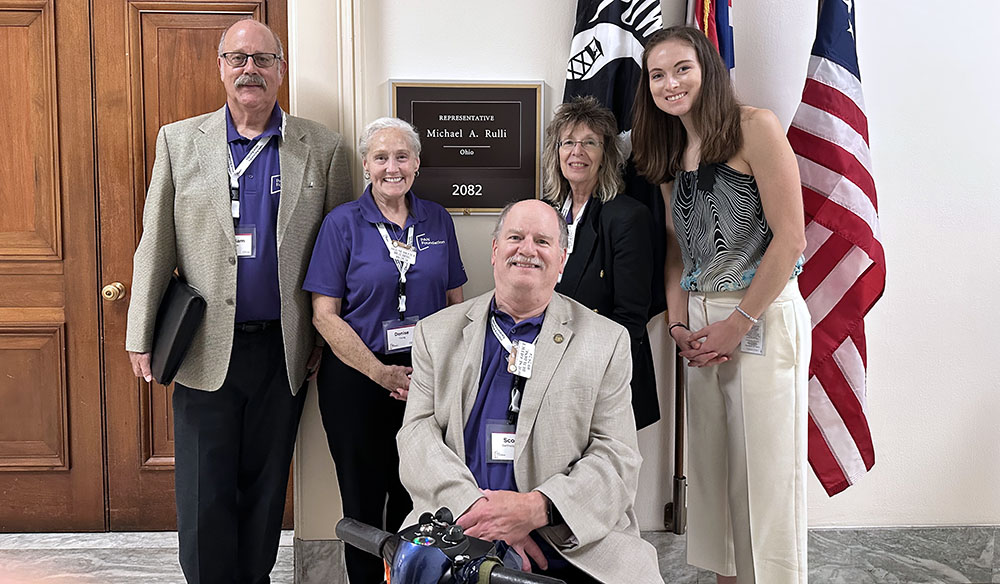
In September 2025, Scott and Maryanne joined PAN’s annual Advocacy Action Summit to ask for an end to harmful insurance practices that delay access to life-saving care. At 67, he wants to bring about change for others in the prime of their youth—just like he was, when MS turned his world upside down.
“I consider [prior authorization and step therapy] to be delay tactics from the insurance companies … and I believe that was a major cause of my disability level. When the PAN Foundation asked me to go to Washington, D.C., and talk about it, I felt like I could possibly keep that from happening to somebody like me,” he said.
Scott’s dedication earned him PAN’s 2025 Grassroots Champion Award, which honors an advocate who has gone above and beyond. Since 2024, he has sent over 60 messages to Congress through PAN’s grassroots advocacy campaigns.
Scott’s life today may be different from what he once envisioned, but it’s still rewarding. He and Maryanne dutifully tend to their organic garden, brimming with zucchini, potatoes, peppers, and the juiciest tomatoes. The high school sweethearts spend lots of quality time with their two daughters and their grandchildren. And they enjoy traveling in their motor home, once driving 5,500 miles round-trip to visit the California and Arizona deserts.
Their motto: “We’re still going to do things that bring us joy, it’s just going to go a little slower.”

Together, we can change lives
Join PAN in our mission to accelerate access to affordable health care. Learn how you can advocate with us, or consider a gift to help patients afford their medication costs.