Facing rising costs, insured Americans want healthcare access protected in 2026
Information about this website: Following the March 2026 merger of Patient Advocate Foundation and the PAN Foundation, this website is now a part of Patient Advocate Foundation and remains active during our website transition.
Where to find information during our transition:
- About the merged organization: uniting.patientadvocate.org
- Financial assistance: totalassist.org
- Additional direct patient services and resources: patientadvocate.org
- Education: panfoundation.org and education.patientadvocate.org
- Clinical trials education: clinicaltrials.panfoundation.org
- Advocacy: npaf.org
- Research: patientinsightinstitute.org
Most insured Americans, facing an increase in out-of-pocket healthcare expenses, say they want policy to focus on affordability and access to care.
National poll findings
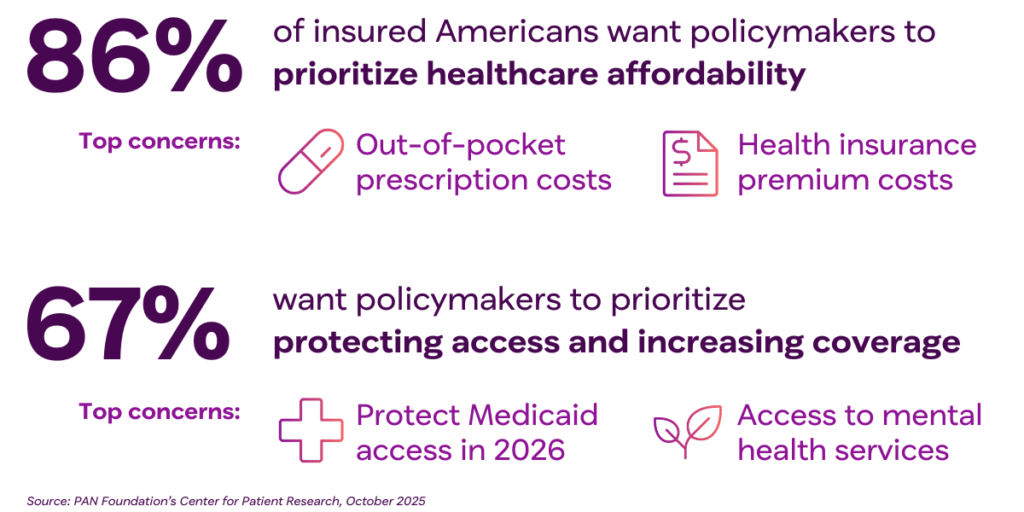
A recent national poll conducted by the PAN Foundation’s Center for Patient Research found that with rising healthcare costs and out-of-pocket spending, most adults (86 percent) want policymakers and elected officials to keep affordability top-of-mind when considering healthcare issues. The top affordability factors of concern are prescription medication costs (33 percent) and health insurance premium costs (32 percent).
In addition, many adults (67 percent) also think policymakers should keep access and coverage related factors in mind, namely protecting access through Medicaid (22 percent) and increasing access to mental health services (16 percent).
The poll also found that more than half of adults (57 percent) are concerned that the ‘One Big Beautiful Bill’ passed in 2025 may prevent access to care for millions of Americans through Medicaid. In addition, nearly half of adults (49 percent) are concerned about the expiration of the premium tax credits for people via the Affordable Care Act (ACA) marketplace, which are set to expire December 31, 2025, without Congressional action.
These concerns also reflect respondents’ experiences in 2025, during which more than half (51 percent) reported taking action over the past year to afford their healthcare costs, such as using their credit care (19 percent), stretching out their prescriptions to make them last longer (11 percent), delaying or cancelling treatments to afford care (11 percent), and not filling prescriptions (9 percent).
Additional findings

Healthcare costs continue to rise, posing barriers to care-particularly to people living with rare and chronic conditions and cancer.
- Four in ten adults (40 percent) will spend more than $1,000 on healthcare out-of-pocket expenses by the end of 2025. Of those, 9 percent will spend more than $5,000 by year’s end. Sixteen percent of people living with rare diseases say they are likely to spend more than $5,000 out-of-pocket for healthcare expenses. Ten percent of people living either with cancer or with a chronic condition said the same.
- Almost 2 in 5 adults (39 percent) experienced an increase in out-of-pocket healthcare costs between 2024 and 2025—with 14 percent experiencing a significant increase.
- More than one-third of adults (34 percent) spent more than $1,000 on monthly insurance premiums, with 18 percent having spent more than $2,500.
- Nearly half of adults (46 percent) experienced an increase in healthcare and prescription premiums since last year, with 13 percent experiencing a significant increase.

People continue to have concerns about affordability and access to care.
- The out-of-pocket costs that most negatively impacted personal budgets in 2025 were health insurance premiums (31 percent), dental care (27 percent), and prescription medication copays (25 percent).
- People living with rare diseases (92 percent) and those with commercial health insurance (76 percent) said they were most likely to have a concern about their access to healthcare when looking ahead to 2026.
“These findings reinforce the critical need for policymakers to address healthcare access and affordability challenges as we look ahead to 2026,” said Amy Niles, Chief Mission Officer at the PAN Foundation. “It’s clear that, for far too many Americans, increased healthcare-related out-of-pocket costs are creating barriers to the care they need and deserve. As a leading charitable assistance foundation and healthcare advocacy organization, we at the PAN Foundation continue to call on policymakers to put patients first by improving healthcare access and affordability for all.”
Polling methodology
This survey was conducted online within the United States between October 7–9, 2025, among 2,084 adults (aged 18 and over), including 1,970 that have some form of health insurance and 1,260 that have a chronic condition, by The Harris Poll on behalf of PAN Foundation via its Harris On Demand omnibus product. Data were weighted where necessary by age, gender, race/ethnicity, region, education, marital status, household size, household income, and political party affiliation, to bring them in line with their actual proportions in the population. Respondents for this survey were selected from among those who have agreed to participate in our surveys.
The sampling precision of Harris online polls is measured by using a Bayesian credible interval. For this study, the sample data is accurate to within ± 2.5 percentage points using a 95% confidence level. This credible interval will be wider among subsets of the surveyed population of interest.
All sample surveys and polls, whether or not they use probability sampling, are subject to other multiple sources of error which are most often not possible to quantify or estimate, including, but not limited to coverage error, error associated with nonresponse, error associated with question wording and response options, and post-survey weighting and adjustments.
About the PAN Foundation
As a leading charitable foundation and healthcare advocacy organization, the PAN Foundation is dedicated to accelerating access to treatment for those who need it most and empowering patients on their healthcare journeys. We provide critical financial assistance for treatment costs, advocate for policy solutions that expand access to care, and deliver education on complex topics—all driven by our belief that everyone deserves access to affordable, equitable healthcare.
Since 2004, our financial assistance programs have helped more than 1.3 million people to start or stay on life-changing treatment. In addition, we’ve achieved major policy victories that increase access to care, mobilized patient advocates to call for change, and educated people nationwide on critical healthcare-related topics. We’re committed to working towards a future where equitable health outcomes are a reality for all. To learn more, visit panfoundation.org.